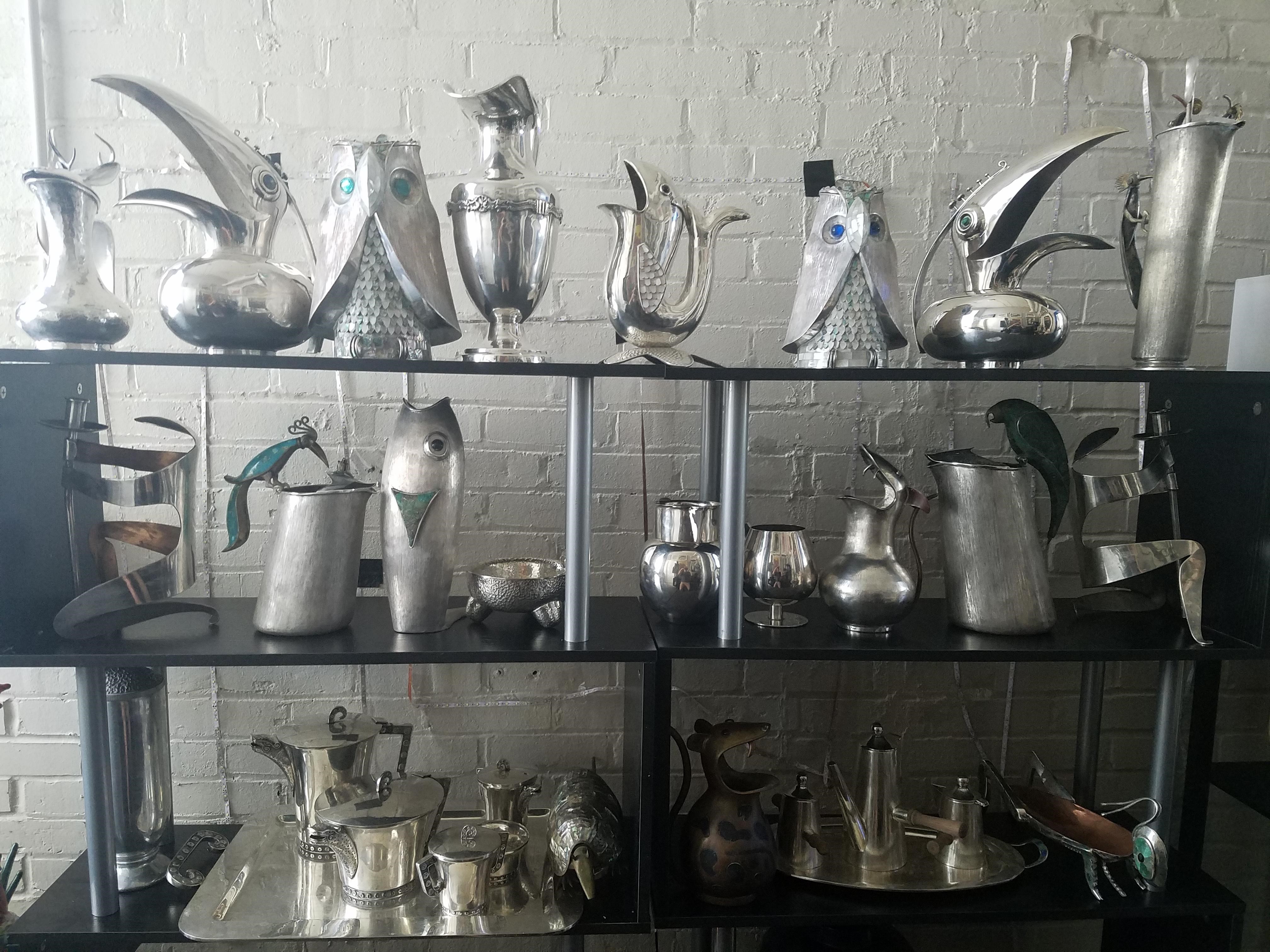
A vast collection of Mexican Silver (including brass) Holloware including; a large selection of Los Castillo, Tane, Antonio Pineda, and Margot Taxco.
WILLIAM SPRATLING
AND THE MEXICAN
SILVER RENAISSANCE
In 1926, a young associate professor of architecture, William Spratling, arrived in Taxco, a pretty little colonial town situated in the mountains of Guerrero state between Mexico City and Acapulco. Ostensibly there to study the baroque architecture, his timing was impeccable. In the wake of a bloody revolution that had raged for a decade between 1910 and 1920, Mexico was ready to embrace a spiritual renewal: artist, poets, musicians, and artisans across the newly democratized nation were inspired to re-evaluate their national identity and cultural traditions.
Artists including Frida Kahlo, Juan O’Gorman, and Diego Rivera descended upon Taxco. Spratling, a New Yorker whose literary aspirations had brought him into the circles of the novelist William Faulkner and essayist Sherwood Anderson, became close friends with Rivera, and he permanently moved to Taxco in 1929.
A couple of years later, the American ambassador Dwight Morrow remarked to Spratling that, while Taxco’s silver mines had yielded thousands of pounds of silver, little of it seemed to have remained in Mexico. This remark inspired Spratling to establish his first taller, or studio, and the legend of what is regarded as Mexico’s silver capital- the crucible of stunning pieces of jewelry, flatware, and other decorative objects- was born.
Spratling had been introduced to pre-Columbian and Mesoamerican art during his time at Tulane University, and these motifs proved a strong influence on his early silver jewelry and decorative objects. Spratling’s studio, which he called Taller de las Delicias (Workshop of the Delights), grew rapidly, and by the late 1930s he was employing several hundred artisans to produce his designs. From there they found their way to North America and into the Neiman Marcus and Saks Fifth Avenue catalogs.
“The father of contemporary Mexican silver”, as Spratling came to be known, incorporated native materials such as amethyst, turquoise, coral, rosewood, and abalone into his creations. Depictions of real and mythical animals, and pre-Columbian motifs of discs, balls, straps and rope designs, were typical. Besides pioneering a new concept of Mexican silver design, Spratling also developed an apprenticeship system to train new silversmiths. Those who showed promise worked under the direction of maestros, and many would later go on to open their own shops.
One of the first of Spratling’s apprentices to strike out on his own was Antonio Pineda, who would arguably become his greatest disciple. As celebrities such as John F. Kennedy, George Gershwin, and Marilyn Monroe began to flock to Taxco- all of them toting a silver souvenir on their sojourn home- Pineda (and his brother Sigi Pineda)established themselves first major modernist silver artists. In fact, Pineda’s own taller was so successful, and his designs in such demand, that the original staff of ten smiths quickly swelled to one hundred.
No other jeweler in Taxco used as many costly semi-precious stones, or set them with as much ingenuity, skill, and variety as did Pineda. Only the most talented of silversmiths could master the challenges posed by setting gemstones in silver at the temperature necessary to work the metal. Pineda, however, managed to set gems with as little metal touching them as possible, giving them a free or floating look while still holding them firmly in place. An appreciation for his creativity, innovation, and craftsmanship have continued to grow through the years, and his works, along with other artists out of the Spratling school, have flourished.
Today there are more than 10,000 silversmiths at work in Taxco. Yet while a small group of fine designers still create hand-wrought silver, the bulk of the work they are producing lacks the design sensibility and technical virtuosity for which Spratling, Pineda, and other artist of that period became renowned. It is these names that are most sought-after by collectors.